Remarkable times call for remarkable change. It's not enough to know a lot about a little, you need to be able to span boundaries and find opportunity in chaos, even if it means you having to risk destruction by breaking with the rules of the past. This is a blog of ideas that challenge conventional thinking about people, technology and the rules that got us here.

A time of remarkable change?

If you've been reading my blogs on Enterprise CIO and Discover Performance, you'll know that I've a part-time career as a soothsayer, trying to predict the future. The central theme to my predictions is that scale and complexity will dictate the future history of companies and public services.

This great little infographic video, "Digital Life: Today and Tomorrow," created by NeoLabels, with a script by Inés Leopoldo of Mitsue Venture tells the story brilliantly. Thanks to Design Taxi for bringing it to my attention.

Turn it up to 11 - Spinal Tap and scalability

My day job gives me the opportunity to talk about the impact of IT changes to companies of all shapes and sizes. One of the common threads that binds them is the desire to be more like SaaS providers Salesforce, Google Docs and the like and less like the corporate IT department of old.

One of the key changes will be preparing for scale before you're even confident that your service will gain traction. One thing I am confident of is that, like the rock gods Spinal Tap, painting an 11 onto your website will not be enough to make them believe the service is any better. Sadly, you're going to have to understand the production line mechanics of the cloud world if you're going to thrive.

"Social isn't a product, social is people and the people are on Facebook"

Former staffer and BFF Guillaume Runser recently sent me a link to James Whittaker's "Why I left Google" post. I get enough email spam from well intentioned friends and family to make a Nigerian envious and usually ignore most of it (sorry Mum!), but GR's a smart dude with a stream-crossing mentality so I thought I'd risk the nano seconds required to scan the link and am glad that I did.

Lady-Gaga's-Swarovski-Teacup-2.jpg

You'll need to push through the opening sentence (unless you're Lady Gaga's teacup, opening with "Everyone wants to know why I left" strikes me as playing fast and loose with the definition of everyone). The wince is worth the reward as James offers up three thought provoking ideas:

Time to reboot last century's IT management model?

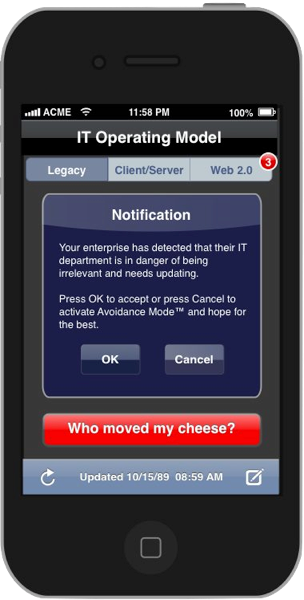
I recently wrote a blog post about the need for IT to change its ways before it becomes irrelevant to the business and was looking for a stock image to accompany it. Nothing really grabbed me - either too cheesy or too abstract.

So I made one...

IT iPhone

"Oh no! Another 2.0!"

I happened upon this presentation from the Economist Group on the future of media consumption and sharing (aka Leanback 2.0) while tooling around Slideshare.

While I couldn't help but wince at the fatigue inducing, PR driven "2-dot-oh" suffix, the content itself was not only deeply interesting but beautifully produced with a reserved sophistication in keeping with The Economist brand.

Worth looking at if only to appreciate the well executed design aesthetic.

Pump it up!

Cracking the WIP

yeswekanbansm.png

In my Top 12 for 2012 I talked about the need to "Reboot IT" and rethink the assumptions, behaviors and processes that have served us well to date but that I believe cannot sustain a modern enterprise in the face of the volume, velocity and value of change required to deliver on the innovation opportunity that Web2.0 and cloud technologies represent.

Google, the jolly green giant or the next dinosaur?

Greenpeace, modern society's conscience in khakis, has largely re-invented itself in the last decade. While it continues to focus on the plight of obviously threatened specifies and habitats, it's raised its ambitions to a whole new level - driving action on macro problems facing the planet as a whole, in particular IT.

cool_it_5_500.jpgThis week they published the fifth annual "Cool IT Leaderboard" ranking technology driven companies by their consumption of renewable resources, advocacy and solutions aimed at helping reduce the impact at the source.

The big surprise of this report was the rapid ascension of Google to the top of the charts, driven in large part by their strong advocacy but even more so by their shift to sourcing 20% of their energy requirements from renewables. With every leader board there has to be a laggard, and Oracle took home the gong in Greenpeace's words for "failing to disclose either renewable or dirty energy use."

While Oracle bashing has become something of a cause célèbre, the real news was those companies that failed to even make the list, notably Apple and Facebook, Apple in particular being singled out on the basis of failing to use it's famously large cash war chest to make a clearer statement to the markets and regulators.

How is this relevant to the boundary spanning audience of this blog? Simply put, "less" truly is "more".  As mammals so ably demonstrated to the dinosaurs, and as recent disasters have tragically brought home, the smaller your footprint - whether that's capital, time, energy, physical space or all four - the better you're able to deal with change.

I'm curious, what's the reality in the trenches of corporate IT - does anyone care about Green IT at all or is it seen as just another distraction?


Pump it up!